
When a factory sensor goes offline in a remote facility, the cause is rarely the sensor. More often, the failure traces back to an edge router that wasn’t built for the environment, couldn’t hold a connection under variable network conditions, or lacked the remote management capabilities required to recover without a costly on-site visit.
Industrial IoT deployments operate in different conditions than office IT infrastructure. Extreme temperatures, high vibration, electromagnetic interference, inconsistent power, and the expectation of five-plus years of continuous uptime make edge router selection one of the most consequential decisions in IIoT architecture.
This guide covers the criteria for evaluating edge routers in industrial environments: how to match devices to physical conditions, what multi-network connectivity means in practice, why remote management capabilities define total cost of ownership, and how security requirements differ in operational technology settings.
What Is an Edge Router in Industrial IoT?
An edge router in industrial IoT is a ruggedized networking device that sits at the boundary between field-deployed sensors or equipment and the broader network infrastructure – processing, routing, and securing data close to where it is generated, rather than transmitting raw data to a central cloud for processing.
Unlike standard commercial routers, industrial edge routers are designed for environments where reliability can’t be traded off against cost: harsh temperatures, physical shock, intermittent power, and remote locations where human intervention is slow and expensive.
The edge router is the connectivity anchor for everything connected to it, like PLCs, sensors, meters, cameras, and other IIoT endpoints. If the router fails, every device behind it goes dark. That dependency is what makes hardware selection critical at deployment.
How Do You Match an Edge Router to an Industrial Environment?
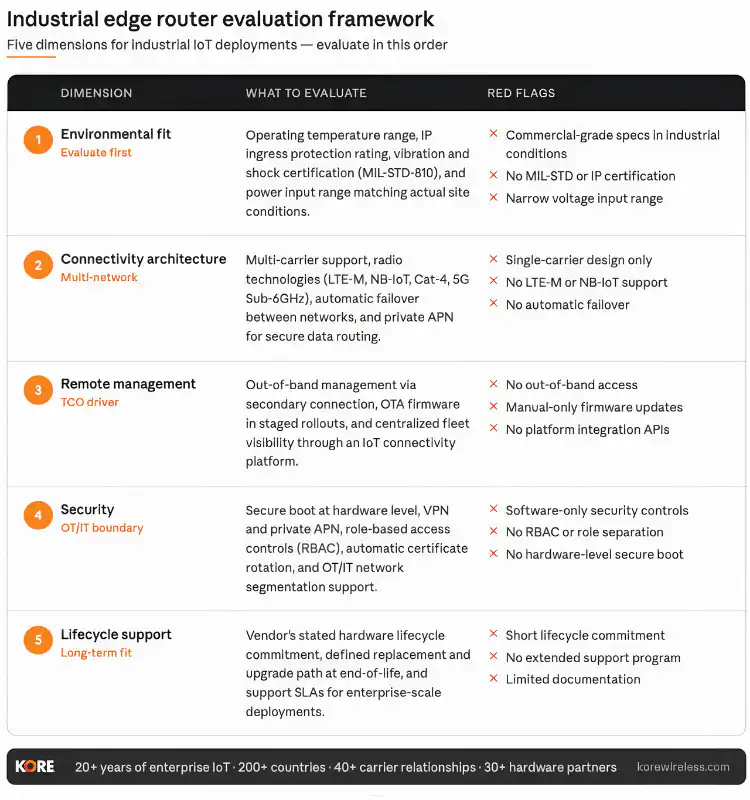
Match the router’s physical specifications – operating temperature, ingress protection rating, vibration tolerance, and input voltage range – to the actual conditions of the deployment site before evaluating any other feature.
Many procurement teams approach industrial edge router selection the way they would any enterprise networking hardware: by comparing throughput, ports, and protocols. In industrial IoT, that approach gets things backwards. Physical environment fit determines whether a device lasts eighteen months or eight years. Evaluate these specifications first:
Operating Temperature Range
Commercial-grade networking hardware is typically rated for 0°C to 40°C. Industrial facilities, outdoor infrastructure, transportation environments, and oil and gas sites routinely exceed those boundaries in both directions. Devices certified to -40°C to +70°C are often the minimum viable specification for field deployment.
Ingress Protection (IP) Rating
The IP rating quantifies resistance to dust and moisture intrusion. In environments with airborne particulates, wash-down cycles, humidity, or outdoor exposure, an IP65 rating (dust-tight, protected against water jets) is typically the floor. Submersible environments require IP67 or IP68. Never deploy commercial-rated hardware in environments that warrant industrial IP ratings – the savings on hardware cost will be absorbed by early replacements and downtime.
Vibration and Shock Tolerance
Equipment mounted near heavy machinery, conveyor systems, or in vehicles faces continuous mechanical stress. Look for MIL-STD-810 or equivalent certification for vibration and shock resistance, particularly for mobile or vehicle-mounted deployments.
Power Input Range
Many industrial sites supply DC power from solar arrays, battery backup systems, or variable-voltage industrial circuits. Confirm that the router’s power input range covers the supply conditions at the deployment site and that it handles voltage fluctuations without data loss, unexpected reboots, or hardware damage.
What Connectivity Architecture Does Industrial IoT Require?
Industrial IoT deployments require multi-network connectivity architecture, or the ability to operate across multiple cellular carriers and technologies, with automatic failover, because single-carrier strategies create single points of failure across geographically distributed infrastructure.
A utility company managing distributed assets across a region will encounter strong LTE coverage in urban substations, variable signal in rural installations, and near-zero connectivity in underground or shielded enclosures. A router locked to one carrier or one radio technology is a liability in that landscape.
Industrial edge routers suited to enterprise IoT deployments should support:
- Multi-carrier cellular connectivity — The ability to connect across multiple carrier networks, not just roam on a single preferred network. In practice, this means selecting hardware compatible with multi-SIM or eSIM functionality so that carrier switching happens without field visits or hardware replacement.
- Multiple radio technologies — Support for LTE Cat-M1, NB-IoT, LTE Cat-4 or Cat-12, and ideally 5G Sub-6GHz, so the router can adapt to the best available technology at each site rather than being constrained by the hardware’s radio capabilities.
- Automatic network failover — Seamless failover between cellular networks, and between cellular and wired backup (Ethernet or fiber), without human intervention. In critical infrastructure deployments, failover time measured in seconds matters.
- Private APN support — For deployments in regulated industries or those handling sensitive operational data, a private APN creates an isolated, encrypted data path from field devices to enterprise systems, bypassing the public internet entirely.
The connectivity infrastructure surrounding the router matters as much as the router itself. Working with an IoT connectivity provider that offers multi-network management gives operations teams the flexibility to optimize coverage, cost, and resilience as a deployment scales.
Why Does Remote Management Define Industrial IoT Total Cost of Ownership?
In industrial IoT, the total cost of ownership for an edge router is determined less by hardware price and more by the operational cost of managing that device over its deployment lifecycle, particularly the cost of field service visits that could have been avoided with proper management infrastructure.
The truck roll, sending a technician to a remote site to physically address a device, is one of the biggest and controllable cost drivers in large industrial IoT deployments. A single field service
visit to a remote infrastructure site can cost several hundred to several thousand dollars when labor, travel, and downtime are accounted for. Across a deployment of thousands of devices, the cost compounds quickly.
Edge routers deployed in industrial settings should support the following remote management capabilities:
Out-of-Band Management
Out-of-band management uses a secondary connection exclusively for device administration, independent of the primary data connection. When the primary link fails, out-of-band access allows engineers to diagnose and reconfigure the router remotely, often resolving issues that would otherwise require a site visit.
Over-the-Air (OTA) Updates
Firmware updates pushed remotely and applied in staged rollouts allow operations teams to patch vulnerabilities, fix bugs, and add functionality without dispatching field technicians. For deployments spanning hundreds or thousands of devices, this capability is an operational requirement.
Centralized Fleet Visibility
Integration with an IoT connectivity management platform gives oper
ations teams a single view of device health, signal quality, data usage, and uptime across the entire deployment. The ability to detect anomalies before they become outages, and to correlate connectivity issues with specific carriers, sites, or device batches, reduces mean time to resolution.
What Security Requirements Apply to Industrial Edge Routers?
Industrial edge routers must satisfy security requirements that go beyond standard enterprise IT hardening, because they operate at the intersection of operational technology (OT) and IT networks, a boundary that, when breached, can affect physical infrastructure, not just data.
As industrial IoT connectivity bridges historically air-gapped OT environments with enterprise IT systems, edge routers become critical security boundaries and potential attack surfaces. The security posture of each device has to align with the sensitivity of the data it handles and the consequences of a compromise.
Security capabilities to evaluate in industrial edge router selection:
- Secure boot — Hardware-level verification that only authenticated firmw
are loads at device startup. Prevents persistent firmware-level malware — an attack vector of particular concern in critical infrastructure.
- VPN and private APN — Encrypts data in transit between field devices and
- Role-based access controls (RBAC) — Limits configuration access to authorized personnel. Required for compliance with industrial security frameworks such as IEC 62443.
- Automatic certificate and credential rotation — Reduces the operational burden of maintaining valid device identities at scale, and limits the blast radius of a single compromised credential.
- Network segmentation support — The ability to isolate OT device traffic from IT traffic at the router level, even when both traverse the same physical connection.
- cloud or on-premises systems without routing traffic through public internet infrastructure.
Edge Router Evaluation Framework: Five Dimensions
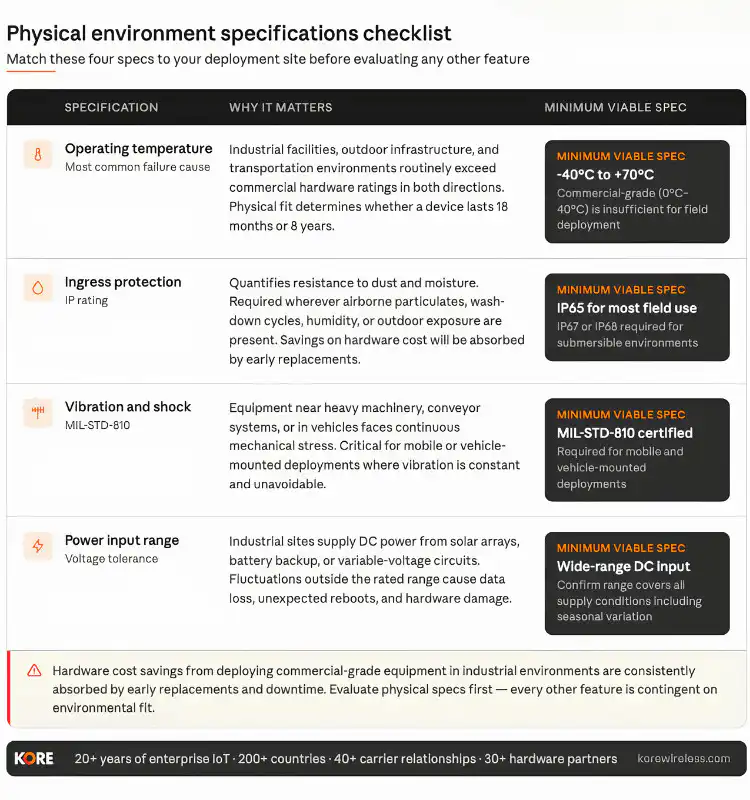
Use this framework to structure the evaluation process across the criteria that matter most in industrial IoT deployments. It is designed to move procurement and engineering teams beyond spec-sheet comparison toward decisions grounded in operational requirements.
| Dimension | What to Evaluate | Red Flags |
| Environmental Fit | Operating temp range, IP rating, vibration/shock certification, power input range | Commercial-grade specs in industrial conditions; no MIL-STD or IP certification |
| Connectivity Architecture | Multi-carrier support, radio technologies, failover capability, private APN support | Single-carrier design; no LTE-M or NB-IoT support; no failover configuration |
| Remote Management | Out-of-band management, OTA firmware updates, platform integration APIs |
No out-of-band access; manual-only firmware updates; no platform integration |
| Security | Secure boot, VPN/private APN, RBAC, certificate management, network segmentation | Software-only security controls; no RBAC; no secure boot certification |
| Lifecycle Support | Hardware lifecycle commitment, replacement/upgrade path, vendor support SLAs | Short product lifecycle; no extended support program; limited documentation |
Questions to Ask Before Selecting an Industrial Edge Router
- Is the device rated for the full operating temperature range of the deployment site, including seasonal extremes?
- Does the IP rating match the environmental exposure at the installation location?
- Does the router support multi-SIM or eSIM functionality for carrier flexibility over the device lifecycle?
- Can it automatically failover between cellular carriers and between cellular and wired backup?
- Does it support out-of-band management via a secondary connection?
- Can firmware be updated remotely, in staged rollouts, without requiring physical access?
- Does it integrate with a centralized IoT connectivity management platform for fleet-wide visibility?
- Does it support private APN configuration for secure, isolated data transmission?
- Is secure boot implemented at the hardware level?
- What is the vendor’s stated hardware lifecycle, and what is the upgrade path when this product reaches end-of-life?
Getting Industrial IoT Edge Infrastructure Right From the Start
Edge router selection is a decision that shapes the reliability and operational cost of an industrial IoT deployment for years after the initial rollout. The hardware that performs reliably in a controlled environment may fail within months in a remote substation. The device that handles a fifty-unit pilot may create management bottlenecks at five hundred. The router that passes initial security review may introduce compliance gaps as the threat landscape evolves.
Getting these decisions right requires more than hardware expertise. It requires understanding the deployment environment in detail, building connectivity architecture for flexibility rather than lowest initial cost, planning remote management capabilities before the first device ships, and treating security as a design requirement, not a configuration task.
For organizations deploying industrial IoT connectivity at scale, those requirements are consistent across verticals: smart manufacturing, utilities, energy infrastructure, and critical public systems all demand the same foundational discipline. What differs is how each criterion is prioritized given the specific operational context.
KORE has supported industrial IoT deployments across these environments for more than two decades providing end-to-end infrastructure, device ecosystem, and management platform that enterprise-grade deployments require. With 30+ hardware partners, 40+ carrier relationships, and connectivity across 200+ countries, the goal is the same in every deployment: simplify the complexity, so the technology works when it needs to.
Planning an industrial IoT deployment? Talk to a KORE expert about connectivity infrastructure, hardware, network, and platform, built for the demands of industrial environments.
Published May 18, 2026.