
IoT devices are often deployed in places where a lost connection isn’t a minor inconvenience. A device that drops off the network can stop transmitting data, interrupt operations, or leave a critical asset effectively invisible.For an enterprise managing connected devices at scale across regions and networks, depending on a single carrier turns that risk into a single point of failure that affects the entire deployment.
Network redundancy is how enterprises reduce that risk. This article explains what IoT network redundancy is, why it matters, how multi-carrier connectivity and automatic failover work, and the strategies you can use to build more resilient deployments, along with what to evaluate when choosing a solution.
What Is IoT Network Redundancy?
IoT network redundancy is the use of multiple connectivity paths or networks so that IoT devices can stay connected when one network becomes unavailable or unreliable.
The purpose of redundancy is to remove single points of failure. If a device depends on one carrier and that carrier has an outage, drops coverage in a location, or sunsets a network technology, the device goes offline with no fallback. Redundancy builds in alternatives, so that when one path fails, another can carry the connection.
It’s worth being precise about the terms here, because they often get used interchangeably when they shouldn’t be. Multi-carrier connectivity is one strategy for achieving network redundancy, but redundancy is the broader goal. Redundancy can involve multiple carrier networks, multiple connectivity technologies, or multiple architectural paths. Multi-carrier is usually the most practical route for cellular IoT, but keeping the distinction clear matters: the objective is a resilient deployment, and multi-carrier is one of the ways to get there.
Redundancy is also different from simply having a strong connection. A single carrier with excellent coverage still represents one point of failure. Redundancy is about what happens when that connection isn’t available, not how good it is when everything is working.
Why Is Network Redundancy Important for IoT?
The value of redundancy comes down to the consequences of losing connectivity. For many IoT deployments, those consequences are significant.
When a connection drops, devices stop transmitting data, and that data is often the entire point of the deployment. Lost or delayed data can interrupt operations, create visibility gaps where teams no longer know the state of an asset, and in some cases carry real revenue or safety implications. Devices in remote or hard-to-reach locations make the problem worse, because restoring connectivity can’t always be done quickly or in person.
The stakes are clearest in deployments where uptime is not optional:
In transportation and fleet, a tracking device that loses connectivity leaves an asset unaccounted for and can disrupt logistics and dispatch. In healthcare, connected devices may support time-sensitive monitoring where a dropped connection has patient-safety consequences. In utilities and energy, grid sensors and smart meters need consistent reporting, often across wide and remote geographies. In manufacturing and industrial settings, connectivity interruptions can disrupt automated processes and operational visibility.
A few strong examples make the point: in these environments, connectivity is infrastructure, and infrastructure needs a fallback.
What Is Multi-Carrier IoT Connectivity?
Multi-carrier IoT connectivity is an approach that lets a device or deployment access more than one cellular network, rather than depending on a single carrier.
With single-carrier connectivity, a device is tied to one network and its coverage, performance, and availability. If that carrier has a gap in a particular area or an outage, the device has no alternative. With multi-carrier connectivity, the device can use whichever available network provides service in its location, which both improves coverage and provides the alternatives that make redundancy possible.
This is why multi-carrier connectivity and redundancy are so closely linked: having access to multiple networks is what allows a deployment to fail over from one to another. But multi-carrier access is the enabler, not the whole story. How a deployment actually switches between networks, and how well that switching is managed, is what determines whether multi-carrier access translates into real resilience.
How Does Multi-Carrier Failover Work?
Failover is the process of moving a device’s connection from one network to another when the first becomes unavailable or falls below acceptable performance. In an IoT deployment, the basic sequence usually looks like this:
- The device connects to a preferred network.
- Connectivity is monitored, either by the SIM, the device, or the connectivity platform.
- The network becomes unavailable or performance drops below an acceptable threshold.
- The connectivity solution identifies another available network.
- The connection switches to the alternate network.
- The device resumes communication.
How this actually behaves depends on the underlying architecture. Failover speed, whether switching is automatic or requires intervention, and which networks are available all depend on the SIM or eSIM capabilities, the device hardware, the provider’s carrier relationships, and the connectivity management platform behind the deployment. Not every multi-carrier SIM behaves identically, and it’s worth understanding a specific solution’s failover logic rather than assuming all multi-carrier options work the same way.
Multi-Carrier vs. Single-Carrier IoT Connectivity
The two approaches serve different needs. The table below compares them, but the right choice depends on the deployment.
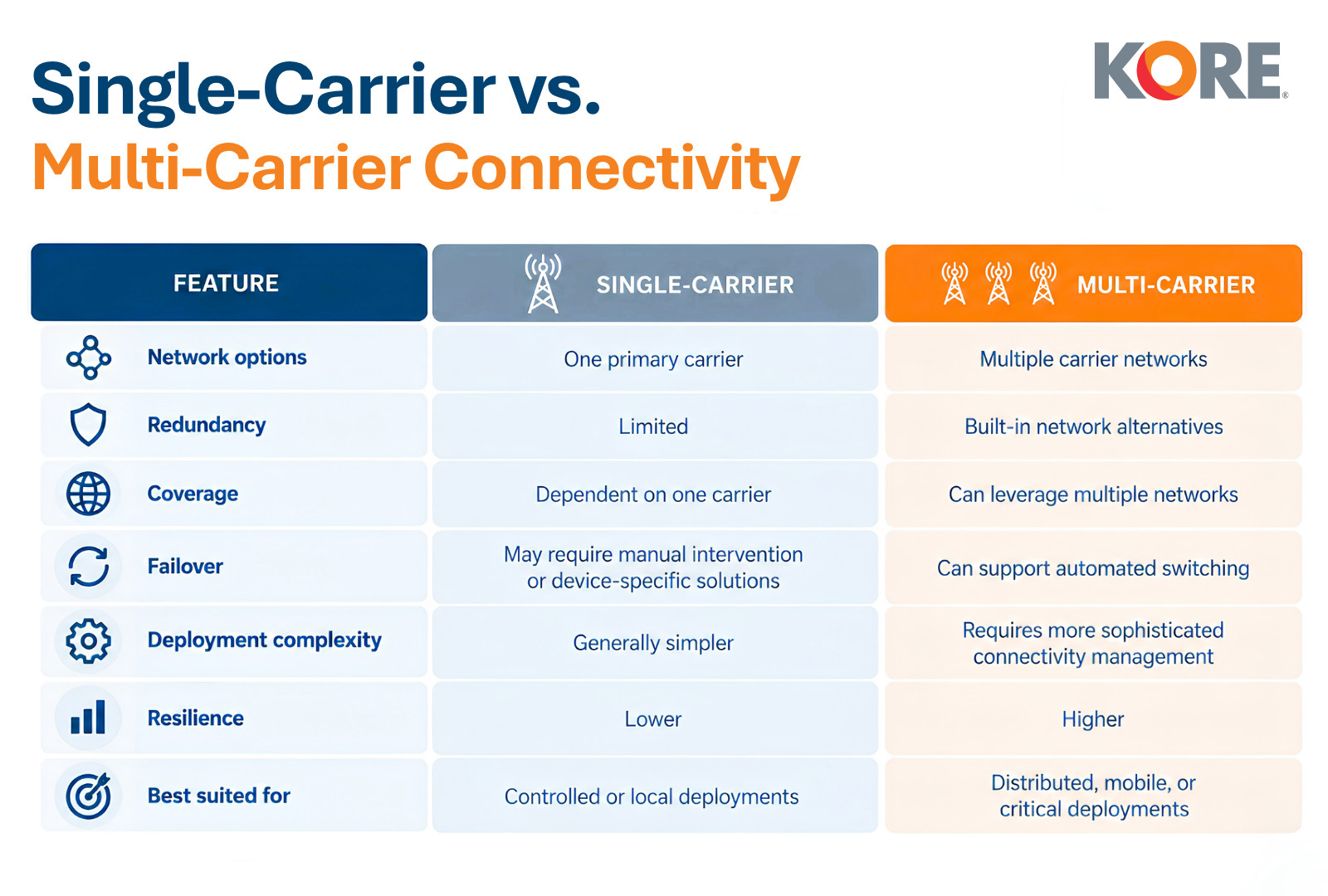
Multi-carrier isn’t universally the right answer. A deployment that’s geographically contained, has reliable single-carrier coverage, and doesn’t carry high consequences for occasional downtime may not need the added complexity or cost. The decision depends on geography, reliability requirements, device capabilities, and budget. The point is to match the level of redundancy to how critical uptime actually is for the deployment.
Strategies for Building a Redundant IoT Network
There’s more than one way to build redundancy into an IoT deployment. Most enterprises use some combination of the following.
Multi-Carrier SIMs
A single SIM or eSIM can provide access to multiple networks, depending on the solution’s architecture. This is often the most straightforward way to give a device connectivity alternatives without changing hardware for each carrier.
Multi-IMSI SIMs
Multi-IMSI means a SIM carries multiple network identities (IMSIs), allowing it to be recognized by and connect to different carrier networks. This supports connectivity across carriers by switching the network identity in use, which can enable faster switching than downloading an entirely new profile.
eSIM and Remote SIM
Provisioning eSIM technology, with remote SIM provisioning, allows carrier profiles to be managed over the air across the device lifecycle. This adds flexibility: connectivity can be updated or changed without physically swapping a SIM, which matters for devices deployed for years or in hard-to-reach locations.
Automatic Network Selection and Failover
Automated switching is far more scalable than manually managing carrier changes across a large fleet. When network selection and failover happen automatically based on availability and performance, teams don’t have to intervene device by device, which is the only practical approach at scale.
Connectivity Monitoring and Management
Redundancy is only useful if you can see and manage it. Effective connectivity monitoring gives teams visibility into network performance across their device fleet, helping them confirm that failover is working and identify where connection problems are occurring. Without that visibility, devices may switch networks or lose service without the enterprise knowing, making it harder to troubleshoot issues and maintain a reliable deployment.
What Should Enterprises Consider When Choosing a Multi-Carrier IoT Solution?
Evaluating a redundant connectivity solution means looking beyond a single feature. The factors that tend to matter most:
Geographic coverage in the regions where devices will actually operate. The number of available carrier networks, particularly in target markets. Automatic failover capabilities and how switching is triggered and managed. SIM and eSIM options that fit the device hardware and deployment. Multi-IMSI support where fast, identity-level switching is needed. Device compatibility with the connectivity approach. Network performance monitoring and the ability to see connectivity status across the fleet. A connectivity management platform for centralized control. Security, including how devices authenticate and how traffic is protected. APIs for automating connectivity tasks and integrating with existing systems. Scalability to grow from a pilot to a large deployment. Pricing and cost structure that fit the deployment’s data and scale profile. Regulatory considerations for the countries involved. Support and service availability when something goes wrong.
The goal isn’t to find the solution with the longest feature list. It’s to match capabilities to the deployment’s reliability requirements, geography, and scale.
IoT Network Redundancy at Scale
Redundancy for 10 devices and redundancy for 100,000 devices are different problems.
At small scale, connectivity issues can be handled reactively and individually. At enterprise scale, that’s impossible. When a deployment spans thousands or hundreds of thousands of devices across regions and networks, the redundancy itself has to be managed as a system, and that depends on centralized capabilities: SIM management, network visibility, usage monitoring, alerts, automation, troubleshooting, and reporting across the entire fleet from one place.
This is where connectivity management becomes essential. Redundancy provides the alternatives that keep devices online; connectivity management is what lets an enterprise actually operate and maintain that redundancy at scale, understand what’s happening across the deployment, and act on it without touching every device by hand.
How KORE Supports Redundant IoT Connectivity
KORE helps enterprises build and manage redundant IoT connectivity through multi-carrier, multi-network access and centralized connectivity management. Rather than tying a deployment to a single carrier, KORE provides access to multiple networks so devices have connectivity alternatives, using multi-IMSI and eSIM technology to support switching across carriers.
Just as important, KORE provides the connectivity management layer that makes redundancy operable at scale. Through a centralized Connectivity Management Platform, enterprises gain visibility into connectivity status, SIM lifecycle management, network monitoring, and APIs for automation and integration, so redundancy isn’t just a capability but something teams can see, manage, and act on across a global deployment.
For enterprises whose operations depend on staying connected, that combination of multi-network access and centralized management is what turns redundancy from a concept into a reliable part of the deployment.
Frequently Asked Questions
What is IoT network redundancy?
IoT network redundancy is the use of multiple connectivity paths or networks so IoT devices can stay connected when one network becomes unavailable or unreliable. Its purpose is to remove single points of failure and improve uptime, which becomes increasingly important as deployments grow.
Why is multi-carrier connectivity important for IoT?
Multi-carrier connectivity gives devices access to more than one cellular network, which improves coverage and provides the alternatives needed for failover. For distributed or uptime-critical deployments, it reduces the risk that a single carrier’s outage or coverage gap takes devices offline.
How does IoT network failover work?
Failover moves a device’s connection from one network to another when the first becomes unavailable or underperforms. The connectivity solution monitors the connection, detects a problem, identifies another available network, and switches to it so the device can resume communication. The exact behavior depends on the SIM, device, and platform.
What is the difference between multi-carrier and single-carrier IoT connectivity?
Single-carrier connectivity ties a device to one network, creating a single point of failure. Multi-carrier connectivity gives a device access to multiple networks, providing redundancy and better coverage. Multi-carrier is generally suited to distributed or critical deployments, while single-carrier can be sufficient for controlled, local ones.
Can an IoT SIM connect to multiple networks?
Yes. Multi-carrier and multi-IMSI SIMs, along with eSIM technology, can allow a single SIM to connect to multiple carrier networks depending on the solution’s architecture. This is what enables a device to switch networks for redundancy rather than depending on one carrier.
How can enterprises improve IoT connectivity reliability?
Enterprises improve reliability by building redundancy into their deployments, typically through multi-carrier connectivity, automatic failover, and centralized connectivity management that provides visibility and control across the fleet. The right approach depends on the deployment’s geography, criticality, and scale.
Managing connectivity across a large or distributed IoT deployment? Learn how KORE’s IoT connectivity management solutions help enterprises build more resilient, reliable connected-device deployments. Explore KORE IoT Connectivity Management.
Published September 18, 2026.