
Procurement conversations in enterprise IoT move fast and the terminology can move even faster. In a single vendor briefing, a technical buyer might encounter SIM profiles, APN configurations, LPWAN radio comparisons, and eSIM provisioning standards – each term carries real architectural implications, and vendors often use slightly different language to describe the same concepts.
This glossary is written for technical buyers who need to evaluate IoT connectivity options with precision: product managers, enterprise architects, OT engineers, and IT procurement leads who are past the basics but want a reliable reference for the terms that come up in vendor conversations, RFPs, and deployment planning.
Terms are grouped by category so you can scan to the section most relevant to your current evaluation rather than reading front to back.
Connectivity Technologies
What is LTE-M (LTE Cat-M1)?
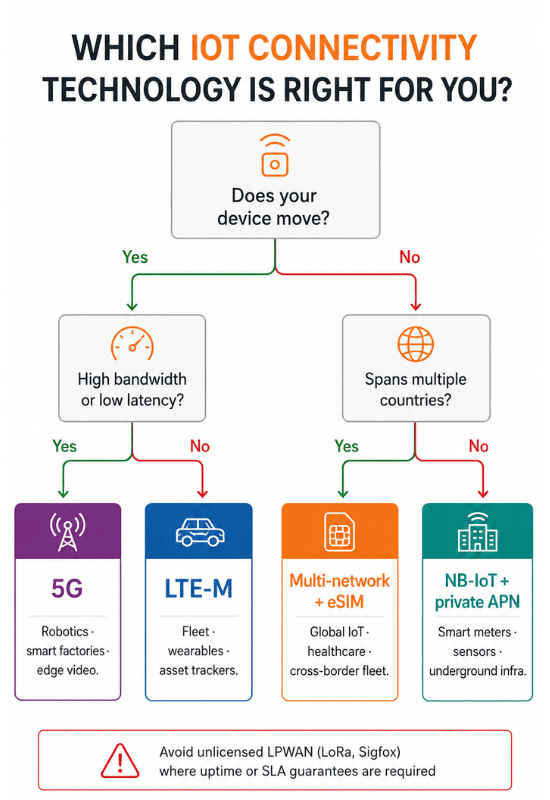
LTE-M is a low-power wide-area network (LPWAN) standard built on existing LTE infrastructure, designed specifically for IoT devices that need moderate data throughput, mobility support, and long battery life.
LTE-M operates in licensed spectrum, which provides the reliability of carrier-managed networks – unlike unlicensed alternatives such as LoRa or Zigbee. It supports voice and is capable of device mobility, making it well-suited for applications like fleet telematics, wearable health monitors, and asset trackers that move between coverage zones. Typical data rates range from 375 Kbps to 1 Mbps.
Relevant for: Fleet management, connected health devices, mobile asset tracking.
What is NB-IoT (Narrowband IoT)?
NB-IoT is an LPWAN standard optimized for stationary, low-power devices that transmit small amounts of data infrequently – prioritizing battery life and deep indoor or underground coverage over throughput or mobility. NB-IoT operates in licensed spectrum within existing LTE bands. Its signal penetration characteristics make it effective in challenging environments: basement utility meters, underground infrastructure sensors, and dense urban deployments where signal strength is limited. It does not support mobility or voice. Battery life can exceed ten years for appropriately designed devices.
Relevant for: Smart metering, utilities monitoring, fixed industrial sensors, smart city infrastructure.
What is 5G for IoT?
In the context of enterprise IoT, 5G refers to the use of 5G networks – particularly Sub-6GHz bands and, in specific use cases, mmWave – to support high-throughput, low-latency device deployments that exceed what LTE can deliver.
5G is not a default replacement for LTE-M or NB-IoT. For low-power, low-data-rate applications, LTE-M and NB-IoT remain more appropriate and more economical. 5G becomes relevant for IoT use cases that require real-time responsiveness (robotic control, autonomous systems), high-bandwidth data streams (industrial vision systems, connected vehicles), or dense device environments where spectrum efficiency matters. Each technology serves a different purpose, and selecting the right one depends on the operational requirements of the deployment.
Relevant for: Smart manufacturing, autonomous vehicles, industrial automation, high-density deployments.
What is an LPWAN?
A Low Power Wide Area Network (LPWAN) is a class of wireless network technology optimized for long-range, low-bandwidth communication between IoT devices that operate on battery power for extended periods.
LTE-M and NB-IoT are the dominant licensed-spectrum LPWAN options for enterprise deployments. Unlicensed alternatives – LoRaWAN, Sigfox – offer lower per-device cost but sacrifice the reliability, security, and SLA guarantees of carrier-managed networks. For enterprise IoT deployments where uptime and data integrity are critical, licensed LPWAN options are often the preferred choice.
SIM and Device Identity
What is an eSIM in IoT?
An eSIM (embedded SIM) is a programmable SIM chip soldered directly into a device at manufacture, whose carrier profile can be updated remotely over-the-air without physically swapping a SIM card.
In IoT deployments, eSIM removes one of the most operationally expensive challenges at scale: the need to physically handle SIM cards across thousands of devices. With eSIM, carrier profiles can be provisioned, switched, or updated remotely –reducing deployment costs, enabling carrier flexibility over the device lifecycle, and supporting global deployments where a single hardware SKU needs to work across multiple carrier environments.
Relevant for: Any deployment where carrier flexibility, global scale, or remote SIM management is a priority.
What is an iSIM?
An iSIM (integrated SIM) takes the eSIM concept further by embedding the SIM functionality directly into the device’s main processor or system-on-chip, rather than as a separate component.
iSIM reduces device size, power consumption, and component count compared to eSIM. It is particularly relevant for constrained IoT devices — small form-factor sensors, wearables, and miniaturized industrial equipment — where physical space and power budget are limiting factors. The functional behavior from a connectivity management perspective is similar to eSIM.
What is a SIM Profile?
A SIM profile is the set of carrier-specific credentials and network access parameters stored on a SIM or eSIM that enables a device to authenticate with and access a particular carrier’s network.
In eSIM-enabled deployments, SIM profiles can be downloaded, activated, deactivated, and deleted remotely. This is what enables over-the-air carrier switching — the device doesn’t change; its active network profile does. Understanding SIM profile management is essential when evaluating eSIM platforms, as the architecture for profile provisioning varies significantly across vendors and standards.
What is SGP.32?
SGP.32 is the GSMA standard for eSIM management in IoT devices, defining how SIM profiles are remotely provisioned and managed on embedded SIMs in machine-to-machine and IoT applications.
SGP.32 (and its predecessor SGP.02) governs the architecture and protocol for IoT eSIM remote SIM provisioning. When evaluating eSIM solutions, confirming SGP.32 compliance ensures interoperability with the broader eSIM ecosystem and avoids proprietary lock-in to a single vendor’s provisioning infrastructure.
Understanding which standard a provider supports, and how mature their implementation is, becomes critical when planning long-term deployments.
What is a Multi-IMSI SIM?
A multi-IMSI SIM stores multiple International Mobile Subscriber Identities on a single SIM card, enabling a device to present different network identities depending on which carrier network it is accessing –without requiring eSIM or over-the-air profile updates.
Multi-IMSI SIMs are often used as a practical alternative to eSIM in legacy hardware that cannot support embedded SIM architecture. They provide some carrier flexibility but are generally less flexible than eSIM for managing connectivity across a large device fleet over time.
Network Architecture
What is an APN (Access Point Name)?
An APN is the gateway configuration that tells a cellular device which network path to use when connecting to external data services – determining how traffic is routed, what IP addressing is applied, and what security policies govern the connection.
In enterprise IoT, APN configuration is a meaningful architectural decision, not a setup detail. A private APN routes device traffic through an isolated network path that bypasses the public internet, providing both security and control over data routing. A shared APN routes traffic through a carrier’s public infrastructure – lower cost, but without the isolation that regulated industries or sensitive OT applications require.
What is a Private APN?
A private APN is a dedicated access point name configuration that routes IoT device traffic through an isolated, enterprise-controlled network path – separated from public internet infrastructure and from other customers on the same carrier network.
Private APNs are standard practice in deployments handling sensitive data: healthcare devices transmitting patient data, financial terminals, industrial control systems, and utilities infrastructure. They support integration with on-premises or private cloud environments via VPN or dedicated circuits, and are typically required to meet compliance obligations in regulated industries.
What is IoT Roaming?
IoT roaming is the ability of a cellular-connected device to connect to a network other than its home carrier’s network when the home network is unavailable or out of range.
Standard roaming – where a SIM connects to a visited network under the home carrier’s roaming agreements – is sufficient for consumer devices but often inadequate for enterprise IoT at scale. Roaming agreements vary by region, data rates on roaming networks may be throttled or deprioritized, and permanent roaming restrictions imposed by some carriers can affect devices that never connect to their home network. Multi-network connectivity architecture – where a device has access to multiple carrier relationships, not just roaming privileges – addresses these limitations more effectively for enterprise deployments.
What is Multi-Network Connectivity?
Multi-network connectivity is an architecture in which an IoT device or deployment has genuine access to multiple carrier networks – not just roaming rights on a single carrier – enabling automatic failover, coverage optimization, and carrier switching without changing hardware.
This is a meaningful distinction from standard roaming. With multi-network connectivity, if one carrier experiences an outage or coverage gap, the device connects to an alternative network without interruption. For enterprise deployments across geographically diverse or remote environments, multi-network architecture is the difference between an acceptable SLA and a genuinely resilient deployment.
For large-scale or globally distributed deployments, this architecture provides the consistency and resilience required to operate without disruption.
Device and Connectivity Management
What is a CMP (Connectivity Management Platform)?
A Connectivity Management Platform is a software system that provides centralized visibility and control over cellular-connected IoT devices – including SIM provisioning, usage monitoring, network diagnostics, and billing management – across an entire device fleet.
Evaluating CMP capabilities is as important as evaluating network coverage when selecting an IoT connectivity provider. A CMP that surfaces real-time signal quality, usage anomalies, and connectivity status can significantly reduce mean time to resolution. It also gives operations teams the visibility needed to manage large fleets without scaling support overhead.What is Zero-Touch Provisioning?
Zero-touch provisioning is a device activation approach in which a device connects to its intended network and receives its configuration automatically upon first power-on, without requiring manual steps by a field technician.
At scale, the difference between manual provisioning and zero-touch provisioning is not a convenience –it is an operational cost variable that compounds across every device in a deployment. Zero-touch provisioning requires alignment between the device manufacturer, connectivity platform, and deployment infrastructure, and should be evaluated as a capability during the pilot stage rather than after hardware has shipped.
What is IoT Device Lifecycle Management?
IoT device lifecycle management refers to the end-to-end operational processes for managing connected devices from initial provisioning through active deployment, maintenance, and eventual decommissioning –including connectivity changes, firmware updates, and hardware replacement.
For enterprise deployments with multi-year hardware lifecycles, lifecycle management is where operational costs accumulate or are controlled. Key capabilities to evaluate: remote decommissioning and SIM suspension to prevent billing on inactive devices, OTA firmware management, and hardware refresh programs from the connectivity provider’s ecosystem of hardware partners.
Security
What is a VPN in IoT Connectivity?
In IoT connectivity, a VPN (Virtual Private Network) creates an encrypted tunnel between field-deployed devices and enterprise network infrastructure, ensuring that data transmitted over cellular networks is protected from interception and cannot be accessed by unauthorized parties on the carrier’s shared infrastructure.
VPN configuration in IoT differs from consumer or enterprise VPN use in that it must operate efficiently on constrained devices and maintain persistent connections across variable cellular conditions. For deployments where data sensitivity or regulatory compliance requires encryption in transit, VPN, often in combination with a private APN, is the standard approach.
What is IoT Security Hardening?
IoT security hardening refers to the set of technical measures applied to connected devices and their network infrastructure to reduce attack surface and limit the impact of a compromise – including secure boot, certificate-based authentication, network segmentation, and role-based access controls.
Security hardening for IoT differs from IT security in that devices are often long-lived, physically exposed, and difficult to update once deployed. The security architecture established at deployment time in both hardware and connectivity infrastructure largely determines the security posture of the deployment for its entire operational life.
Putting the Terminology to Work
A glossary is only useful if it translates into better vendor conversations and sharper procurement decisions. The terms above recur in every serious IoT connectivity evaluation – in RFP responses, in architecture reviews, and in the questions that reveal whether a provider’s capabilities match their marketing.
The questions that separate capable IoT connectivity providers from the rest are highly specific: not “do you support eSIM?” but “which provisioning standard do you support, and what does profile switching look like at 10,000 devices?” Not “do you offer global coverage?” but “is that coverage through owned carrier relationships or standard roaming agreements, and how does it perform in the regions we’re deploying to?”
Understanding the terminology gives you the tools to ask those questions and evaluate the answers with confidence.
KORE has supported enterprise IoT deployments across connected health, fleet, industrial, and utilities environments for more than two decades. With 21M+ active SIMs, 40+ carrier relationships, and coverage across 200+ countries, we help organizations deploy, manage, and scale connectivity with confidence without being locked into a single network, region, or technology path.
Published May 19, 2026.